The Learn Series · The Plant
One plant, many cigars: ligero, viso, seco, and the ladder of the leaf.
A single tobacco plant doesn't grow one kind of leaf — it grows several. The height a leaf reaches decides how much sun it drinks, how thick and strong it becomes, and, in the end, whether it will spend its life as mild aroma, rich mid-body, or raw power. Blenders read a tobacco plant like a ladder.
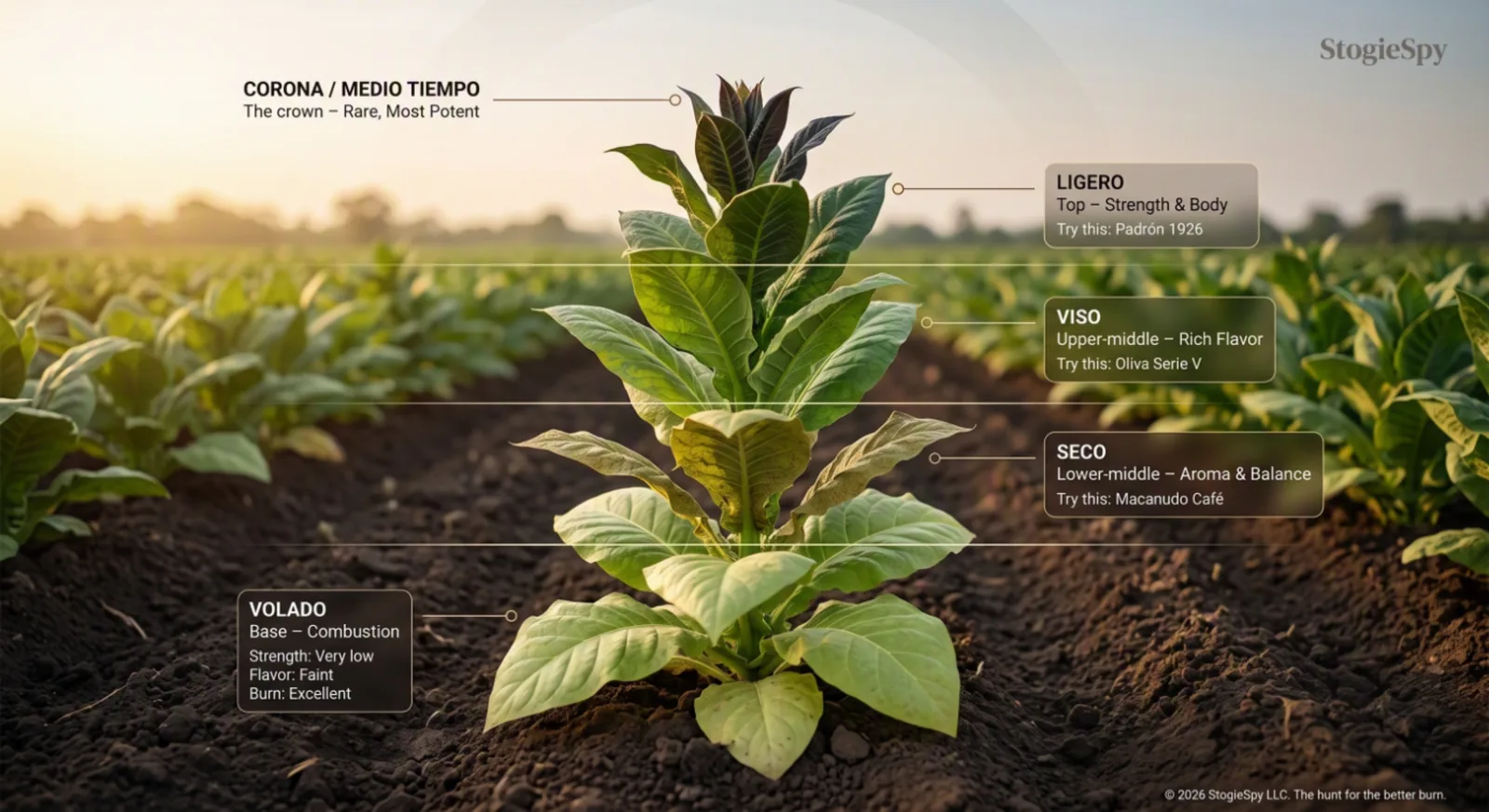
A tobacco plant is harvested in stages, not all at once. Starting a few weeks after the plant flowers, workers pick the leaves in horizontal bands — first the lowest, then, every week or so, the next band up — until they reach the crown. Each band is a priming, and its position on the stalk is destiny. Lower leaves grow in the shade of the ones above and see less sun; higher leaves bake in full light for longer. That single difference — how much sun a leaf drinks and how long it hangs — is why one plant yields tobaccos that range from feather-light to blast-furnace strong. Here's the ladder, from the ground up.
Volado
Base of the plant · the leaf that keeps a cigar lit
At the bottom of the stalk grows volado — the thinnest, lightest leaf on the plant, and the one that sees the least sun. It contributes almost no flavor and almost no strength, which sounds like a flaw until you learn its real job: combustion. Low-priming leaf is the most combustible tobacco on the plant, and a pinch of it in the filler is what keeps a cigar burning evenly instead of going out between puffs. Blenders treat volado as the burn insurance in a bunch.
Because it's mild and elastic, volado (and the closely related lowest seco leaves) is also a common binder — burn quality and stretch matter more there than flavor. You'll notice not every cigar's spec sheet mentions volado by name; some blenders fold it into "seco," and plenty of full-bodied blends skip it entirely, borrowing burn quality from their seco instead. When you see it, read it as: this maker cared about a clean, even burn.
Seco
Lower-middle of the plant · aroma and balance
Move up to the lower-middle of the stalk and you reach seco — Spanish for "dry." These leaves are thinner and lighter than the ones above them, mild in strength, and prized for aroma: seco carries much of the nose and the subtler top-notes of a blend. It also burns cleanly, so it does double duty, supplying flavor and helping the bunch smoke cool and even. Seco is the volume leaf of most blends — often the single largest share of the filler — precisely because it's the balancing tobacco: enough character to matter, mild enough not to dominate.
Seco is also the most versatile priming by role. Its thin, even leaves make excellent binder, and lower-priming leaf like seco often becomes the milder, silkier wrappers too — especially when it's shade-grown under cloth (as with a classic Connecticut Shade), a growing method that keeps the leaf thin and pale on top of its low position on the stalk. When a cigar reads "mild-to-medium and aromatic," you're usually tasting a seco-forward recipe.
Macanudo Café → — the archetypal seco-forward, aroma-first mild cigar: gentle, cedary, and famously even-burning, built to show what the lower-middle of the plant does best.
Viso
Upper-middle of the plant · the flavor in the middle
Higher again, in the upper-middle of the plant, sits viso — the leaf that gets more sun than seco but hasn't reached the raw intensity of the top. That extra light thickens it and deepens its oils, and the payoff is flavor: viso is where a blend's richness and mid-palate body come from. It's the bridge tobacco — stronger and fuller than seco, smoother and more forgiving than ligero — and adding more of it is how a blender pushes a cigar from medium toward medium-full without turning it into a bruiser.
Viso earns its keep in the filler, but its combination of body and reasonable elasticity also makes many sun-grown wrappers upper-middle leaf. Recall the Sobremesa blend sheet from the previous article: it used two different visos, from two different farms, to layer mid-palate complexity — a textbook demonstration of how much a blender leans on this priming for flavor.
Oliva Serie V → — built around Nicaraguan viso and ligero, it's a benchmark for the rich, full-flavored mid-palate that the upper-middle of the plant delivers, without tipping into harshness.
Ligero
Top of the plant · strength, body, and slow burn
At the top of the plant, in full unbroken sun, grows ligero — the engine room. (The name literally means "light," an old reference to its color at harvest, which is misleading: in the cigar it is the heavy leaf.) These are the thickest, oiliest, darkest, and most powerful leaves the plant produces, packed with the most concentrated flavor and the highest strength. Ligero is what gives a full-bodied cigar its depth, its weight, and its kick.
Two quirks define how ligero is used. First, because it's so thick and oily, it burns slowly and reluctantly — which is exactly why it's rolled into the center of the filler bunch, wrapped in faster-burning seco and viso that coax it along. (This is the ligero core marked in the diagram in the binder-and-filler article.) Second, it's used with restraint: a little ligero adds richness and strength; too much makes a cigar harsh, tar-heavy, and prone to going out. Blenders speak of "dosing" ligero the way a chef doses salt. It's almost never used as wrapper or binder — it's too coarse and too slow-burning for either.
Padrón 1926 Serie No. 2 → — a full-bodied Nicaraguan puro that shows what a generous, expertly dosed measure of ligero delivers: dense cocoa, coffee, and pepper with real power behind it.
Medio Tiempo & the corona
The crown · rare, potent, and often not there at all
Above even the ligero, at the very crown of the plant, a few plants grow a last pair or two of tiny, super-charged leaves called medio tiempo ("middle time"). They're the most potent, most concentrated tobacco a plant can make — but they only appear if the plant is left standing long enough after the ligero is picked, and not every plant produces them at all. That rarity is the whole story: medio tiempo is used in vanishingly small amounts, as a final accent that adds intensity and a lingering finish. The top pair of leaves, sometimes called the corona, sits in the same crown zone.
You've encountered medio tiempo whether you knew it or not — it's the "secret ingredient" behind some famously powerful modern cigars, brought to prominence when Cuba's Cohiba Behike put it on the label. Think of it as ligero's rarer, wilder sibling: same neighborhood on the plant, dialed up.
La Flor Dominicana Andalusian Bull → — Litto Gomez is one of the few makers who feature medio tiempo openly; this Cigar Aficionado Cigar of the Year is a masterclass in crown-leaf power kept in balance.
The ladder at a glance
From the base up — what each priming becomes and adds
| Priming | Position | Sun & body | Becomes | What it adds |
|---|---|---|---|---|
| Volado | Base | Least sun · thinnest | Filler, binder | Combustion — keeps it lit |
| Seco | Lower-middle | Low sun · thin | Filler, binder, mild wrapper | Aroma & balance |
| Viso | Upper-middle | More sun · medium | Filler, sun-grown wrapper | Rich mid-palate flavor |
| Ligero | Top | Full sun · thick, oily | Filler core only | Strength, body, depth |
| Medio Tiempo | Crown | Most sun · tiny, rare | Filler accent | Peak intensity & finish |
A closing word: the next time a cigar reads "medium-bodied," picture the ladder. That phrase is really a ratio — a lot of seco and viso, a careful dose of ligero, maybe a whisper of volado to keep it burning. Strength, flavor, aroma, and burn aren't magic; they're four leaves from four heights on one plant, balanced by someone who knew exactly what each rung would give.
Know the leaf. Find the cigar.
Every cigar above links to a live StogieSpy price comparison — the best landed price per stick across premium online retailers. Put the theory to work.
Compare cigar prices →