The Learn Series · Binder & Filler
What's under the wrapper? Binder, filler, and the art of the blend.
The wrapper gets the photograph, but roughly nine-tenths of the tobacco in a premium cigar is hidden beneath it. The binder and the filler do most of the work — and deciding exactly which leaves go inside is the closest thing the cigar world has to a dark art.
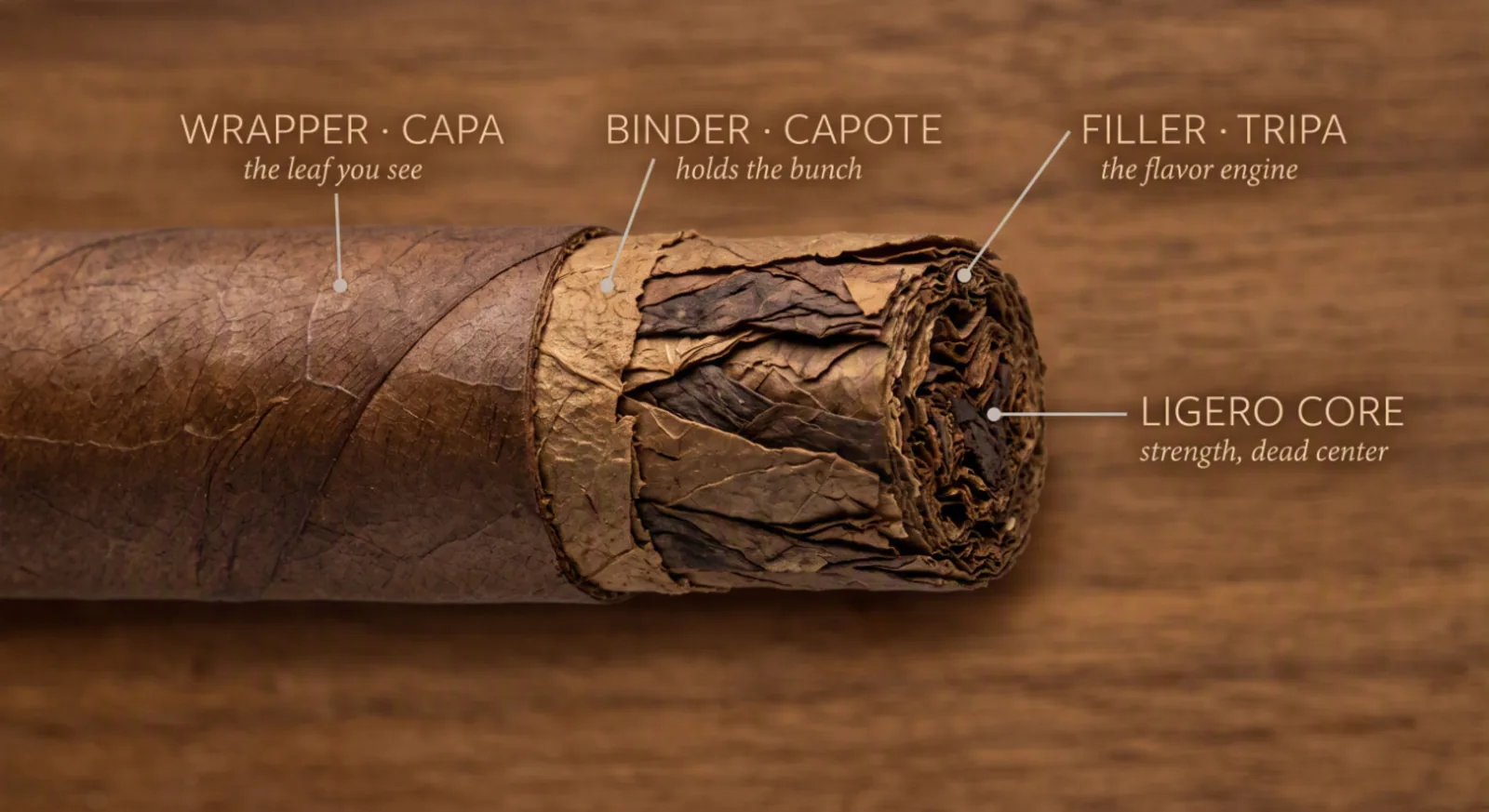
Every premium handmade cigar is three things: a wrapper (capa), the single beautiful leaf on the outside; a binder (capote), the workhorse leaf just beneath it; and the filler (tripa), the bundle of leaves at the core that makes up most of what you actually smoke. We covered the wrapper — and its eight shades — in the first article in this series. This one goes inside: what the binder and filler each do, and how a master blender decides, leaf by leaf, what a cigar will taste like before a single one is rolled for sale.
The binder — the leaf that holds it all together
Capote · structure, combustion, and quiet flavor
Directly beneath the wrapper sits the binder: one tough, elastic leaf rolled around the filler bunch to hold its shape before the wrapper goes on. If the wrapper is the cigar's suit, the binder is its skeleton. A roller shapes the filler leaves into a cylinder, wraps the binder around them, and presses the result in a mold — only then is the delicate, expensive wrapper applied over the top.
Because its job is structural, a binder is picked for different virtues than a wrapper. It needs tensile strength and elasticity so it can be stretched around the bunch without splitting, and it needs to burn evenly, because a binder that fights the burn will wreck the whole cigar. Looks barely matter — binders are often leaves from the same plants and primings as wrapper tobacco that didn't make the cosmetic cut: a water spot, a coarse vein, a mottled patch. Same leaf, same flavor potential, a fraction of the price.
That doesn't make the binder mute. A Connecticut Broadleaf binder brings a dark, earthy sweetness; a Mexican San Andrés binder adds cocoa and burn-correcting reliability; a Nicaraguan Habano binder pushes spice. Some modern blends even run two binders, using the second the way a cook uses a bay leaf — a background note you'd miss if it were gone. Blenders will tell you the binder is the least glamorous decision they make and one of the most consequential: it's the difference between a cigar that burns straight, cool, and effortless and one that tunnels, cones, and needs constant relights.
The filler — the flavor engine
Tripa · where body, strength, and complexity live
Inside the binder is the filler — the bundle of leaves that makes up the bulk of the cigar and delivers most of its body and strength. In a premium handmade, this is long filler (tripa larga): whole leaves running the full length of the cigar, folded lengthwise so air can travel from foot to head. Machine-made and budget cigars use short filler (tripa corta) — chopped scraps and clippings — which burns hotter and faster; "Cuban sandwich" cigars split the difference by folding short filler inside a few long leaves.
A long-filler blend is rarely one tobacco. It's usually three to five different leaves, and each one is chosen from a specific spot on the tobacco plant: seco from the lower-middle of the stalk for aroma and an even burn, viso from higher up for body and richer flavor, and a measured dose of ligero — the thick, dark, slow-burning leaf from the top of the plant — for strength. The ligero always goes dead center in the bunch, surrounded by faster-burning leaf; it smolders reluctantly, so burying it in the core keeps the cigar lit and gives the ash its solid center. (What these primings are, and why the top of a plant smokes so differently from the bottom, is the subject of the next article in this series.)
How the leaves are bunched matters too. The most labor-intensive method, entubado, rolls each filler leaf into its own little tube before bunching, creating parallel air channels and a famously open draw. The accordion method pleats each leaf's edges inward; the book method stacks leaves flat and folds them like the pages of a paperback. Most factories use accordion or book bunching for speed; entubado survives at factories willing to pay for the draw it produces.
And crucially, the filler is where geography compounds: a single cigar might carry Nicaraguan viso from Condega, Dominican seco of Olor seed, and a Pennsylvania Broadleaf ligero — three countries in one bunch, each leaf doing a different job.
The art of the blend
Fuma tasting · flavor memory · iteration
So how does a blender decide what goes inside? Not by mixing at random. The craft rests on a discipline that sounds almost monastic: before a tobacco earns a place in any blend, the blender learns it alone.
The core technique is the single-tobacco test smoke — widely called a fuma (from the Spanish fumar, to smoke; you'll also hear purito or "test cylinder"). One tobacco — a single varietal, from a single priming, from a single farm and crop year — is rolled by itself into a plain, unbanded cigar and smoked with full attention. No wrapper flourish, no blend to hide behind. A fuma of Condega seco tastes like exactly one thing: Condega seco. Smoked this way, leaf by leaf, a blender builds a mental library — a flavor memory — of every tobacco in the warehouse: what it gives, what it lacks, how it burns, how hard it hits. Davidoff's Dominican operation runs this exercise systematically, rolling single-varietal cylinders from individual microclimates so the team can taste how the same seed shifts from one valley to the next. Steve Saka has made the same point from the blender's chair: tobaccos that share a name are not interchangeable — a ligero from one farm is not the ligero from the next, and a seco is not just a seco. A fuma is how you learn the difference.
Only then does composition start. Most blenders begin with an intent, not a recipe — Saka describes starting from a target character ("strong and spicy, but smooth") and working backward to the leaves that can deliver it. Candidate blends are rolled in a neutral test vitola, rested, and smoked; ratios shift a quarter-leaf at a time; a seco from one farm swaps in for another. The samples go to panel tastings — at the big houses, dozens of smokers evaluate a candidate blend day after day — and the whole cycle repeats for months. A blend that tastes right must also behave: burn straight, draw open, hold an ash. And it must be repeatable — a blender who builds a masterpiece on a tobacco they can only source for one season has built a limited edition, not a brand. It's why the great houses age deep inventories of leaf for years before a blend built on them ever ships.
The people behind the recipes
Master blenders worth knowing by name
Wine has winemakers; cigars have blenders. A handful of names come up over and over when smokers talk about the modern era, and once you know them, you start recognizing their signatures across brands.
Hendrik "Henke" Kelner
Davidoff · Dominican Republic
The industrial engineer who became Davidoff's tobacco guru. In the business since 1969 and head of Davidoff's Dominican production since 1990, Kelner turned blending into a science of "total palate stimulation" — mapping how Piloto, Olor, and San Vicente tobaccos each strike different zones of the tongue — and bred new hybrids (including the Ecuador-grown "702" wrapper) when the leaf he wanted didn't exist. The Davidoff house style — polished, complex, immaculate — is his life's work, now carried on by sons Hendrik Jr. and Klaas.
Steve Saka
Dunbarton Tobacco & Trust · Nicaragua
As head of Drew Estate, Saka co-created Liga Privada — the cigar that made "dark and oily" a modern obsession. In 2015 he founded Dunbarton Tobacco & Trust and launched Sobremesa, Mi Querida, and Sin Compromiso, each accompanied by something almost unheard of: the complete recipe, published for anyone to read. A self-described "cigar dork," he's the industry's loudest voice for the idea that where a leaf grows matters as much as what it's called.
José "Don Pepín" García
My Father Cigars · Nicaragua
A Cuban roller and factory man who arrived in the U.S. in the early 2000s and promptly changed the flavor of the market. His blends — for his family's My Father brand and, famously, for Tatuaje — carry an unmistakable opening blast of black pepper smokers call the "Pepín twang." With son Jaime, he built one of Nicaragua's most decorated factories, including Flor de las Antillas and My Father Le Bijou 1922, both former Cigar Aficionado Cigars of the Year.
Ernesto Perez-Carrillo
E.P. Carrillo · Dominican Republic
The man behind the 1990s La Gloria Cubana boom started over in 2009 with his own family company — and won Cigar Aficionado's Cigar of the Year twice in three years (Encore Majestic, 2018; Pledge Prequel, 2020). Five decades in, his blends are studies in balance: full flavor that never bullies the palate.
A.J. Fernández
Tabacalera AJ Fernández · Nicaragua
Grandson of a Cuban grower, A.J. built an empire in Estelí on vertical integration — his farms, his factories, his leaf. Beyond his own New World and San Lotano lines, he's the industry's most in-demand contract blender, quietly making or blending cigars for many of the biggest names in the business.
Nick Melillo
Foundation Cigar Co. · Nicaragua
Drew Estate's former head of tobacco — the leaf man behind the Liga Privada era's inventory — went independent in 2015 with Foundation. His blends (Tabernacle, Olmec, The Upsetters) read like a leaf-broker's greatest hits, and his candela evangelism came up in our wrapper article.
Case study: a cigar that shows you everything
Sobremesa · the published blend, decoded
Most cigar makers describe their blends in a shrug of a sentence: "Nicaraguan wrapper, Nicaraguan binder, Nicaraguan filler." Steve Saka went the other way. When he launched Sobremesa — the first cigar from Dunbarton Tobacco & Trust — he published the entire recipe: every leaf, its seed variety, its priming, and the growing region it came from. It remains one of the best windows into how a real blend is engineered, so let's read it the way a blender would.
Sobremesa — the full published blend
| Wrapper | Ecuador Habano, grade 1 dark rosado (La Meca) The reddish, oily face of the cigar — sweetness and polish up front. |
|---|---|
| Binder | Mexican Negro de Temporal (Matacapan, San Andrés region) A rustic Mexican leaf chosen for elasticity, an even burn, and a dark earthy undertone. |
| Filler 1 | Nicaraguan GK C-SG seco — Condega The aroma layer, and the leaf that keeps the whole bunch burning cool. |
| Filler 2 | Nicaraguan Criollo viso — Pueblo Nuevo Mid-stalk body: richer flavor without ligero weight. |
| Filler 3 | Nicaraguan C-98 viso — La Joya, Estelí A second viso from a different farm — depth through layering, not just strength. |
| Filler 4 | Nicaraguan hybrid ligero — ASP, Estelí The power plant, buried in the core of the bunch. |
| Filler 5 | Broadleaf ligero — Lancaster County, Pennsylvania An American accent: dark, sweet strength that Nicaraguan leaf alone can't supply. |
Notice what the sheet teaches. Five filler tobaccos, and no two do the same job: one seco for aroma and combustion, two visos from different towns for layered mid-palate flavor, and two ligeros — one Nicaraguan, one Pennsylvanian — splitting the strength duties between spice and dark sweetness. This is why "Nicaraguan filler" on a product page tells you so little: within one country, Condega, Pueblo Nuevo, and Estelí grow recognizably different tobacco, and a blender is choosing between them on purpose. Every choice in this table is the product of exactly the fuma-tasting discipline described above — you can only write a recipe this precise about leaves you know individually.
Dunbarton Sobremesa → — taste the blend sheet above in the flesh, then see if you can pick out the Pennsylvania broadleaf's dark sweetness in the final third. Its shade-wrapped sibling Sobremesa Brûlée shows how a new wrapper transforms the same core idea.
A closing word: none of this is trivia for its own sake. Once you know what a binder does, a badly burning cigar stops being bad luck. Once you know what seco, viso, and ligero contribute, "medium-bodied" stops being marketing and starts being a ratio. The blend sheet is the cigar — everything else is presentation.
Ready to taste a blend, not just read one?
Every cigar above links to a live StogieSpy price comparison — the best landed price per stick across premium online retailers. Find the blend, skip the overpaying.
Compare cigar prices →