Ask a cigar smoker why a boutique stick costs eighteen dollars and a good number will say the same thing: you're paying for the marketing.
They're right. They're just wrong about what the marketing is.
In Part 1 we traced the physical cost of a cigar from the rolling table to the shelf. This piece is about the layer that doesn't show up in any of it — the money spent making you want the cigar — and it turns out to be one of the strangest marketing economies in consumer goods.
The premium cigar industry does not buy ads
Researchers at NORC tracked every dollar of measured advertising in the cigar category from January 2017 through July 2022 — consumer magazines, trade magazines, newspapers, TV, radio, outdoor, and digital — using Kantar's expenditure data.
Here's what five and a half years looked like.
Tracked advertising spend · Jan 2017 – Jul 2022
Everyone else is buying the ads
Inflation-adjusted to 2022 dollars. The premium cigar category — the thing this whole series is about — is the short bar.
That's roughly $400,000 a year for the entire premium category — less than a single regional car dealership group. Source: Carter, Binns, Emery & Kostygina, Tobacco Control (2024), Kantar/Vivvix tracked expenditures.
The top five advertisers in the premium category over that whole window:
| Advertiser | Spend |
|---|---|
| Thompson & Co. — retailer | $528,766 |
| Drew Estate | $416,521 |
| Tatuaje Nation | $223,790 |
| J.C. Newman | $146,140 |
| Holt's Cigar Co. — retailer | $142,545 |
Two of the five aren't manufacturers at all. Retailers outspent brands roughly sixteen to one on advertising.
So if you're picturing your cigar's price inflated by glossy magazine spreads, the arithmetic doesn't support it. Something else is happening.
The money goes to the trade
Premium cigars are sold through roughly 3,000 independent retailers. Those retailers are the entire distribution system, and they are the audience the marketing money is aimed at — not you.
The center of that world is the PCA trade show, and PCA publishes its rates.
Floor space is sold by the square foot on a sliding scale: $28.60 for a small booth down to $21.96 for 4,000 square feet and up. A modest 10×20 booth is $5,720 in floor rent. A serious 20×30 presence is $17,160. Corners cost $200 extra, peninsulas $400, islands $800. Fifty percent down at signing, and every dollar is non-refundable.
That's the floor. Not the booth build, the freight, the drayage, the electrical, the flights, the hotel block, the staff, or the cigars you hand out.
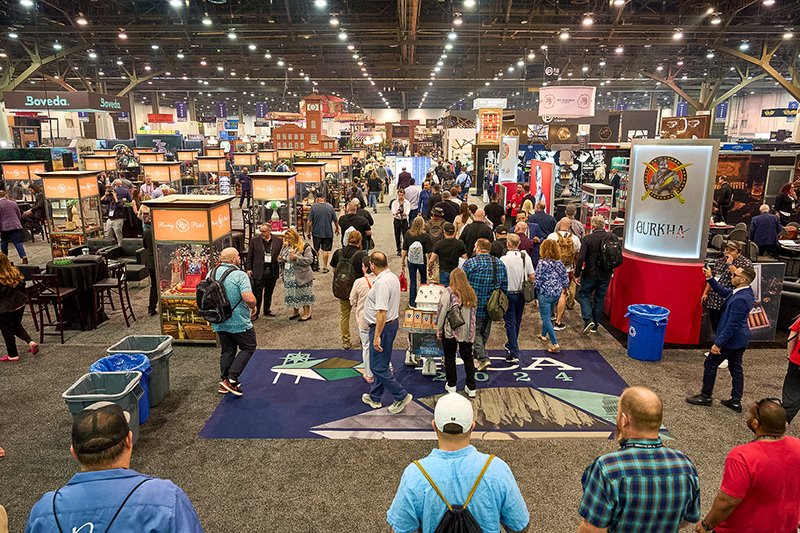
Sponsorships sit on top, and the rate card reads like a luxury auction. At the time we pulled it, most of the list was already sold out.
PCA26 · published sponsorship rates
What it costs to be seen by 3,000 shop owners
For scale: when four large manufacturers withdrew from the 2019 show they represented 27,500 square feet — over eighteen percent of the floor — and industry reporting estimated they had been contributing more than $750,000 through booths and sponsorships alone.
The line item nobody counts
Look closely at the sponsorship descriptions. Nearly every experience-based package includes some version of the same phrase: distribute your cigars to all attendees.
That is not included in the fee. That is inventory.
Sponsor an education session for $10,000 and you also hand out several hundred cigars. Sponsor the opening reception for $60,000 and thousands of attendees receive one of yours on the way in. Buy the welcome cigar slot for $5,000 a day and you're giving one to every retailer walking through registration.
At a $2 factory cost, a few thousand giveaway cigars is real money — and at a boutique's cost basis it can rival the sponsorship fee itself.
This continues at the retail level all year. In-store events, brand nights, meet-the-maker evenings — the brand supplies the rep, the travel, the swag, and the cigars. Earlier this year the Boutique Cigar Association published an open warning to retailers about exactly this: that the escalation of free-cigar giveaways has become a market-share weapon large companies can afford and small ones cannot.
The brand ambassador layer runs on similar economics from the other direction. In the premium space, ambassadors are frequently compensated in product, event access, and covered travel rather than cash — freelance arrangements that can end without notice. It's a marketing channel that looks expensive on Instagram and is often remarkably cheap on the P&L.
The trade show isn't marketing overhead. It's the sales channel.
Why the money routes this way
Three structural reasons, and they explain the whole shape of the industry.
Advertising is legally constrained
FDA deeming rules require warning labels on cigar advertising across essentially every medium — print, outdoor, websites, email, social media, mobile. And the major paid platforms restrict tobacco-adjacent advertising outright. A cigar brand largely cannot run the campaign a whiskey brand runs.
The buyer isn't you
A brand with no shelf space has no business. Getting into three thousand independent shops requires convincing three thousand owners, and you convince them in person, at a show, over a cigar.
The category is small
Around 430 million premium cigars enter the U.S. annually. Nicaragua ships about 59 percent of them, the Dominican Republic and Honduras nearly all the rest. That's a real business, but it is not a mass market, and mass-market advertising math doesn't close.
So how much of your cigar is marketing?
Here's the part that actually answers the question, and the answer depends entirely on scale.
The same marketing, two different businesses
It's the denominator
Marketing and overhead are largely fixed costs. Fixed costs divided by small numbers are large numbers.
Boutique · first run
$1.50–2.50
of marketing in every single cigar
One 10×10 booth, all-in with build,
freight, flights and giveaways:
≈ $15,000–25,000 ÷ 10,000 cigars
Established brand
$0.25
of marketing in every single cigar
1,500 sq ft booth, two major sponsorships,
national sales force, event support:
≈ $500,000 ÷ 2,000,000 cigars
For a new boutique, the go-to-market spend and the cost of goods are roughly the same number. That is not a metaphor.
This is the real reason boutique cigars cost more. Not because the tobacco is better — often it comes from the same fields, sometimes the same factory floor. Not because the rollers are better paid. It's arithmetic.
When you pay $18 for a boutique stick and $12 for a mainstream one made three buildings away in Estelí, a meaningful chunk of that six-dollar difference is simply the difference between dividing by ten thousand and dividing by two million.
The honest version of "you're paying for marketing"
You are. But not in the way people mean it.
You are not paying for advertising — the category barely buys any. You are paying for:
- Distribution. The cost of getting a cigar in front of three thousand independent owners and convincing them to give it humidor space.
- Sampling. Every cigar handed out free at a show, an event, or a lounge was manufactured, taxed, and shipped, and somebody paid for it.
- Trade infrastructure. Booth space, sponsorships, sales reps, samples, travel — the machinery of a business that sells through people rather than screens.
- Small scale. The single largest marketing cost driver in this industry isn't extravagance. It's the denominator.
None of that is waste. A cigar nobody has heard of and no shop carries is not a cheaper cigar — it's an unsold cigar.
But it does mean "premium" in this category is partly a distribution story, not purely a tobacco story. Two cigars with comparable leaf, comparable construction, and comparable aging can differ by six dollars because of how many of them exist.
What to do with this
Judge the cigar, not the brand budget. A quiet brand that skips the show and sells through a handful of shops isn't cutting corners on tobacco. They're cutting corners on your awareness of them — which is exactly where the bargains live.
Treat the trade show release calendar as a price signal, not a quality signal. A show exclusive is a cigar with a sponsorship budget attached. Sometimes that's a great cigar. The budget isn't the evidence.
And then shop the last markup. Because after every one of these costs is settled — the leaf, the aging, the excise tax, the booth, the giveaways — the same cigar still trades in a 29 percent median band across the retailers we track.
Everything in these two articles is fixed by the time the box ships. That last spread isn't.
Next in this series · Part Three
How to buy premium cigars efficiently
We measured what singles, 5-packs, and boxes actually cost across 83 retailers, then worked out whether you should be buying cigars now to smoke in five years. One of the answers argues against what a price comparison site is supposed to tell you.