
A hand-rolled robusto leaves a factory in Estelí for somewhere between one and three and a half dollars. That same cigar sits on a shelf in Denver at twenty.
The gap is not one thing. It is eight or nine things stacked on top of each other, and almost every article you'll read about it blames the wrong one. So we went and priced each layer.
What the factory actually charges
If you wanted to launch a cigar brand tomorrow, you would not build a factory. You would do what most brands do: contract with one of the sixty-odd factories clustered in Estelí, or their counterparts in Danlí and Santiago.
The going rate for that is $1.00 to $3.50 per cigar, depending on the quality of the leaf and how many origins you're pulling from. Minimums run 3,000 cigars for a white-label blend with basic bands and boxes, and 10,000 if you want a custom blend developed for you.
That number covers everything physical about the cigar. Consider what's inside it:
The leaf
Wrapper tobacco runs $25 to $50 a pound depending on varietal, and wrapper alone is roughly a third of what it costs to make a cigar. A single leaf-grade decision moves the whole cost basis by a third.
The labor
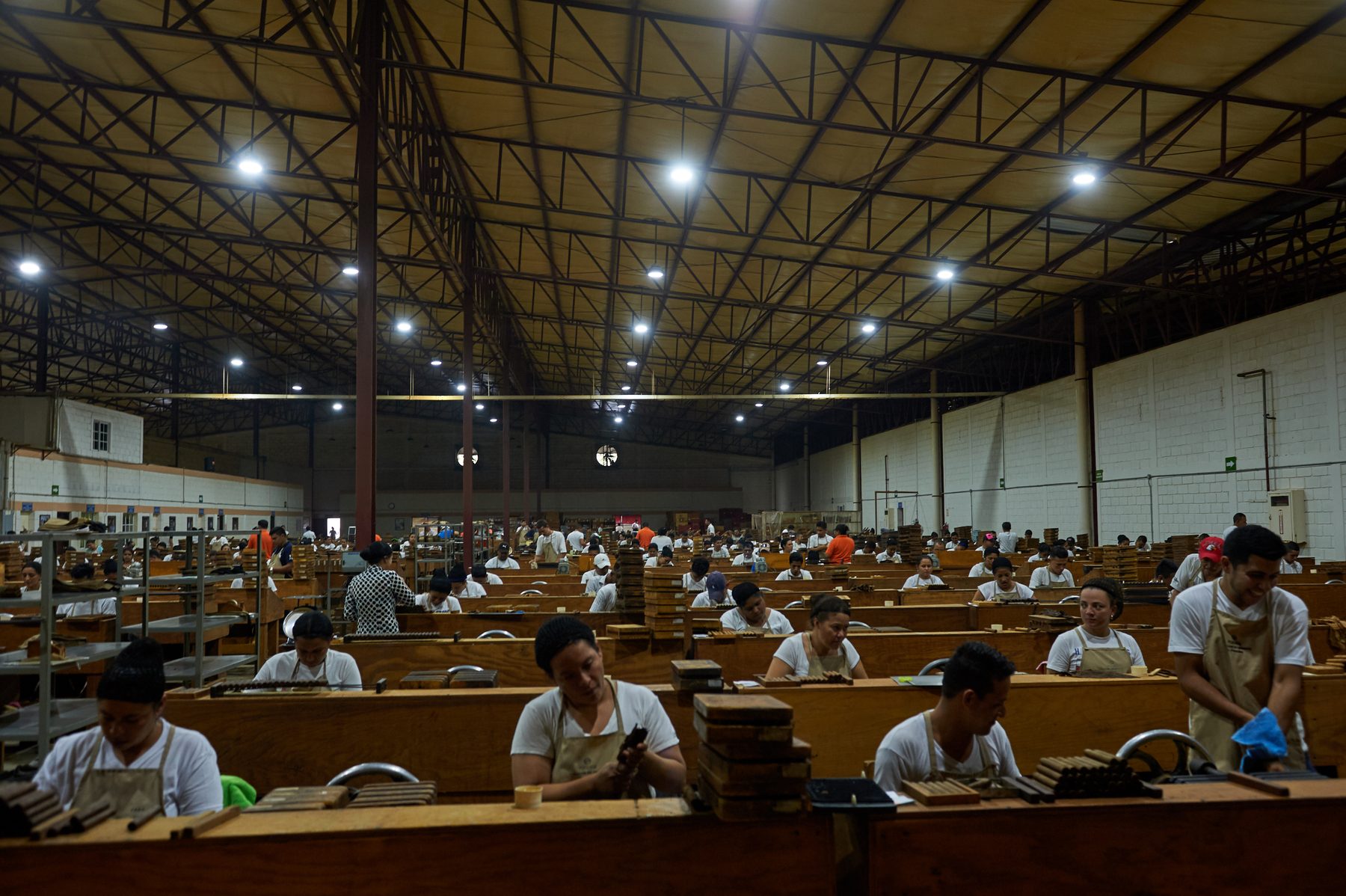
Nicaraguan bunchers and rollers work in pairs and are paid per cigar that passes quality control — not by the hour. A skilled pair earns two to three times what a textile worker makes and four to five times a farm hand. At the larger factories that's up to about $350 a month plus transport, daycare, a canteen, and a clinic.
Whatever else you conclude about cigar pricing, the rolling itself is not where your money goes.
The dress
A basic MDF box with ordinary bands runs about $4 per twenty cigars. A well-made Spanish cedar box with good embossed bands runs about $12 per twenty. Bands alone can be 50 to 80 cents apiece, applied by hand. At real volume a box lands around 18 cents a cigar; a small producer pays considerably more.
Add it up and the physical cigar — leaf, labor, box, band, cellophane — is a few dollars. On a $12 stick, the factory is capturing something in the neighborhood of 15 to 25 percent.
The one cost nobody sees: time
Here is the part that separates a $6 cigar from a $16 cigar made with tobacco from the same fields.
Take a manufacturer who buys a million dollars of leaf. He ferments it six months and ages it another six. He's borrowing at six percent for a year on inventory he cannot sell, so that million becomes $1.06 million before a single cigar is rolled.
Now suppose he wants a five-year-aged blend. Same six-month fermentation, then sixty more months of aging. That million becomes $1.39 million — and that's just interest. The leaf still has to be warehoused, guarded, and insured for five years.
Worse: if he wants that blend as a permanent line rather than a one-off, he has to start buying every year for the pipeline. Buy in 2026 for a 2032 release, buy in 2027 for 2033, and so on. He is roughly six million dollars committed before he sells his first cigar.
Aged tobacco isn't an ingredient. It's a financing decision. When a brand tells you a cigar rested for five years, they are telling you they carried the cost of money for five years.
The taxman takes less than you think, and more than you think
This is the most-mangled number in cigar writing, so let's be precise.
Federal excise tax on large cigars is 52.75 percent of the manufacturer's or importer's sale price — capped at 40.26 cents per cigar.
The cap kicks in once the manufacturer's price passes about 76 cents, which means every hand-rolled premium cigar in existence clears it. So the federal tax on your $12 robusto is not 52.75 percent of anything. It is a flat 40.26 cents — about 3.4 percent of the shelf price. Add roughly a nickel for the FDA user fee. Neither ever appears on your receipt; both are baked into wholesale.
Then there's the state, and the state is where it gets wild.
| State | Tax per cigar |
|---|---|
| Utah | $5.07 |
| New York, Alaska | $4.42 |
| Washington, D.C. | $4.19 |
| Colorado | $3.30 |
| California | $3.12 |
| Most capped states | $0.50 |
| Texas | $0.01 |
| Florida, Pennsylvania, New Hampshire | $0.00 |
Tax Foundation, Premium Cigar Taxes by State, 2024, modelled on a cigar retailing at $11.79.
That is a five-dollar swing on the same cigar depending on which side of a state line it's sold. Seventeen states cap the per-cigar tax, most at fifty cents. Three exempt premium cigars entirely.
If you have ever wondered why so many of the big online retailers ship from Florida, Pennsylvania, and New Hampshire — that's your answer, and it has nothing to do with humidity.
The two markups that do the real damage
Between the factory door and your hand, the cigar is marked up twice.
First markup: the brand. Everything between the $1–3.50 factory cost and the price a retailer pays lives here — the federal tax, the FDA fee, ocean freight, duty, insurance, climate-controlled warehousing, the sales force that calls on shops, trade show spend, and the brand's own profit.
We can see the output of that markup because distributors publish it. A Padrón Exclusivo Maduro wholesales around $8.40. A Romeo y Julieta 1875 wholesales around $2.50.
Second markup: the retailer. A well-run brick-and-mortar cigar program targets a blended 45 to 55 percent gross margin, and it varies by tier in a way that surprises people.
| Tier | Retail | Gross margin | Turn |
|---|---|---|---|
| Value | $6–10 | 35–45% | 30–60d |
| Premium | $12–18 | 45–55% | 45–90d |
| Boutique | $18–28 | 50–60% | 60–120d |
| Ultra-premium | $25–80 | 40–55% | 90–180d |
Note that ultra-premium margin is lower in percentage terms than boutique. Retailers new to cigars find this counterintuitive. The reason is simple: wholesale cost on allocation brands is high and the market price is disciplined by what a customer will actually pay. Nobody gets to invent a price for a Liga Privada.
Run those wholesale anchors through the retail math and you get the real picture. That Padrón wholesaling at $8.40 belongs on a shelf at $19 to $21 — the retailer is capturing roughly 57 to 60 percent. The Romeo y Julieta wholesaling at $2.50 belongs at $7.50 to $8.50 — closer to 70 percent.
And if you're smoking it in a hotel lounge or a casino, add another 20 to 40 percent on top of that. You're buying the room.
The stack, assembled
Where twelve dollars goes
An illustrative build for a $12 Nicaraguan robusto in a moderate-tax state. Each band's height is its share of the shelf price. The endpoints are sourced; the interior is inference.
Wholesale to the retailer lands at about $4.50 — roughly 38% of shelf. In Utah the state band alone would be $5.07; in Florida it disappears entirely.
Rank the slices by dollars removed and the order is: the retailer, then the brand, then the government, then — last — the people who actually made the cigar.
That's the finding, and it isn't a scandal. Retail is expensive. A cigar shop carries six-figure inventory that has to be humidified year-round, turns some of it twice a year, employs people who can actually talk about tobacco, and pays rent on a room where nobody is obligated to buy anything. Fifty percent gross margin is not fifty percent profit.
The largest single markup in the chain is the last one — and it's the only one you get to shop.
Which brings us to the number we actually measured
The cost stack explains why a cigar costs twelve dollars rather than three. It does not explain why the same cigar costs different amounts on the same day.
So we checked. We took 75 widely-stocked cigars from 24 major brands — every one carried by at least ten retailers we track — and compared the cheapest and dearest per-stick box price for each, after trimming outliers.
The median gap between the cheapest and most expensive place to buy the same cigar is 29 percent. Sixty-one percent of cigars vary by more than 25 percent. A third vary by more than 40 percent.
Same cigar · same box · same week
What one cigar costs, depending on where you click
Per-stick box price across every retailer StogieSpy tracks. The bar spans cheapest to dearest; the white tick is the median.
Boxes of 15+ only, outliers trimmed. Everything upstream of the shelf — the leaf, the aging, the excise tax, the ocean freight — is identical across every listing above.
Identical cigars. Identical boxes. Same week. The spread is entirely retail markup, state tax, and shipping policy.
What this means if you buy cigars
- Stop blaming the factory. The people rolling your cigar capture the smallest slice of what you pay. That's true whether the cigar is $6 or $26.
- Age is a legitimate premium. When a brand carries leaf for five years, they're financing inventory at commercial rates for half a decade. That cost is real and it's in the price.
- Know your state. A Utah smoker and a Florida smoker pay a five-dollar-per-cigar difference in tax on the identical stick. If your state is expensive, out-of-state retailers are doing more for you than any coupon.
- Compare the last markup. It's the biggest one and the only one that moves. Twenty-nine percent is the median gap. On a box of 25, that's real money.
- Support your local shop deliberately, not accidentally. A good B&M earns its margin with humidification, curation, and a place to sit. Pay it when you're getting it. Don't pay it by default on a box you're taking straight home.
Next in this series · Part Two
Marketing is a bigger part of your cigar's price than you think — and it's almost never advertising
We pulled the entire measured advertising spend of the premium cigar category. It comes to about $400,000 a year, less than a single mid-size campaign in almost any other industry. Then we pulled the trade show rate card, and it started to make sense.