The first two parts of this series were about where your money goes. Part 1 traced the cost stack from the rolling table to the shelf. Part 2 followed the marketing money and found it isn't going where anyone thinks.
This one is about what you can actually do with that knowledge.
We pulled live pricing across our full catalog — 6,772 cigars, 83 retailers, nearly 88,000 price observations — and measured the things cigar smokers argue about instead of measuring.
The short answer
Buy boxes of cigars you've already proven you like, from whoever has the lowest total landed cost, in orders big enough to clear free shipping, and then leave them alone.
Everything below is either the evidence for that sentence or the exceptions to it.
Boxes, 5-packs, singles: the actual numbers
There are two separate penalties for buying small, and almost everyone only knows about the first one.
If you hold the retailer constant and just compare what one shop charges for a box versus a 5-pack versus a single, the markup is modest. Six percent to break open a box is not larceny. About a fifth of the time the small pack is actually priced at or below the box rate.
So far, so reasonable. Now the part that matters.
The packaging penalty, measured two ways
What buying small actually costs
The pale bar is the markup at one shop's own counter. The lit bar is what you really pay once shipping and the rest of the market are counted. The gap between them is the finding.
Same shop: +6.1% Best box anywhere: +19.8% Median penalty $1.40 per cigar
Same shop: +11.1% Best box anywhere: +35.0%
Markup at the same retailer Added by shipping and lost market access
Only 9% of the time is a 5-pack cheaper per stick than the best box on the market. Per-stick landed cost, boxes of 15+, 150 sampled products across 28 brands.
Two things caused the jump from six percent to twenty.
Shipping
Shipping is quoted free on roughly 61% of offers. On the rest, the median charge is $8.99 and we've recorded as high as $28.00. Nine dollars spread across a 5-pack of $8 cigars is $1.80 a stick — a 22% surcharge on the cigar itself. That same nine dollars across a box of 25 is 36 cents. Freight is a fixed cost, and fixed costs divided by five hurt.
Market access
The shop with the best box price is usually not the shop with the best 5-pack price. When you commit to a small quantity you're effectively shopping a smaller market — and in Part 1 we found the same cigar trades in a 29% median band across retailers. Small orders forfeit most of that spread.
So should you always buy boxes? No.
Here's the honest reframing, and it's the opposite of what a price comparison site is supposed to tell you.
A box of 25 at $8 is a $200 decision. A 5-pack of the same cigar at $9.40 is a $47 decision. The 5-pack costs you $7 in overpay.
Seven dollars to avoid a two-hundred-dollar mistake is not a premium. It's a bargain.
The 5-pack markup is best understood as an option premium — you're paying about $1.40 a stick for the right to not commit. Price it that way and the decision rule writes itself.
| Where you are | What to buy |
|---|---|
| Never smoked it | Single, if available. Otherwise a 5-pack. |
| Smoked one, liked it | 5-pack. Across different weeks, moods, and drinks. One good cigar is an anecdote. |
| Smoked five, it's in rotation | Box. Always. From the cheapest landed source you can find. |
| Someone gave it 94 points | Nothing. A rating is one palate, one cigar, one afternoon. |
The single most expensive habit in this hobby is not buying boxes. It's buying boxes of cigars you haven't earned an opinion about yet.
The three markups you can actually move
Once you know what you want, three levers remain. In order of size:
1 · Your state's excise tax — worth up to $5.07 a cigar
From Part 1: on a cigar retailing around $11.79, state excise runs from $5.07 in Utah and $4.42 in New York and Alaska down to zero in Florida, Pennsylvania, and New Hampshire. This dwarfs every other lever combined. If you live in a high-tax state, where you buy matters more than what you buy, how much you buy, or when. Rules on out-of-state tobacco purchases vary and some states pursue collection — check yours rather than assuming.
2 · The retail spread — median 29%
Everything upstream of the shelf is fixed by the time a box ships. The last markup is the only one that moves, and it moves a lot: 61% of products varied by more than 25%, a third by more than 40%.
3 · Coupons — another 9% on top
Of the products we track with active coupon pricing, the median saving is 9.3% off the already-cheapest listed price, reaching 24% at the top end. Roughly one product in four has one available at any given moment.
Stack that on the retail spread and the difference between a careless purchase and a careful one on the same box is routinely 30–40%.
The trap: discounts measured against MSRP
Part 2 explained that some brands set a high MSRP specifically so the cigar can be discounted at point of sale. Here's what that looks like in live data — two cigars from our current deals feed.
| Cigar | Off MSRP | Off market |
|---|---|---|
| Gurkha Crest Toro Maduro | 67% | 4% |
| La Flor Dominicana Andalusian Bull | 58% | 24% |
Both are genuine discounts. One of them is meaningfully cheaper than the market and one is a price tag with a bigger number crossed out next to it.
MSRP is a manufacturer's suggestion. The only baseline that means anything is what the same cigar costs somewhere else this week.
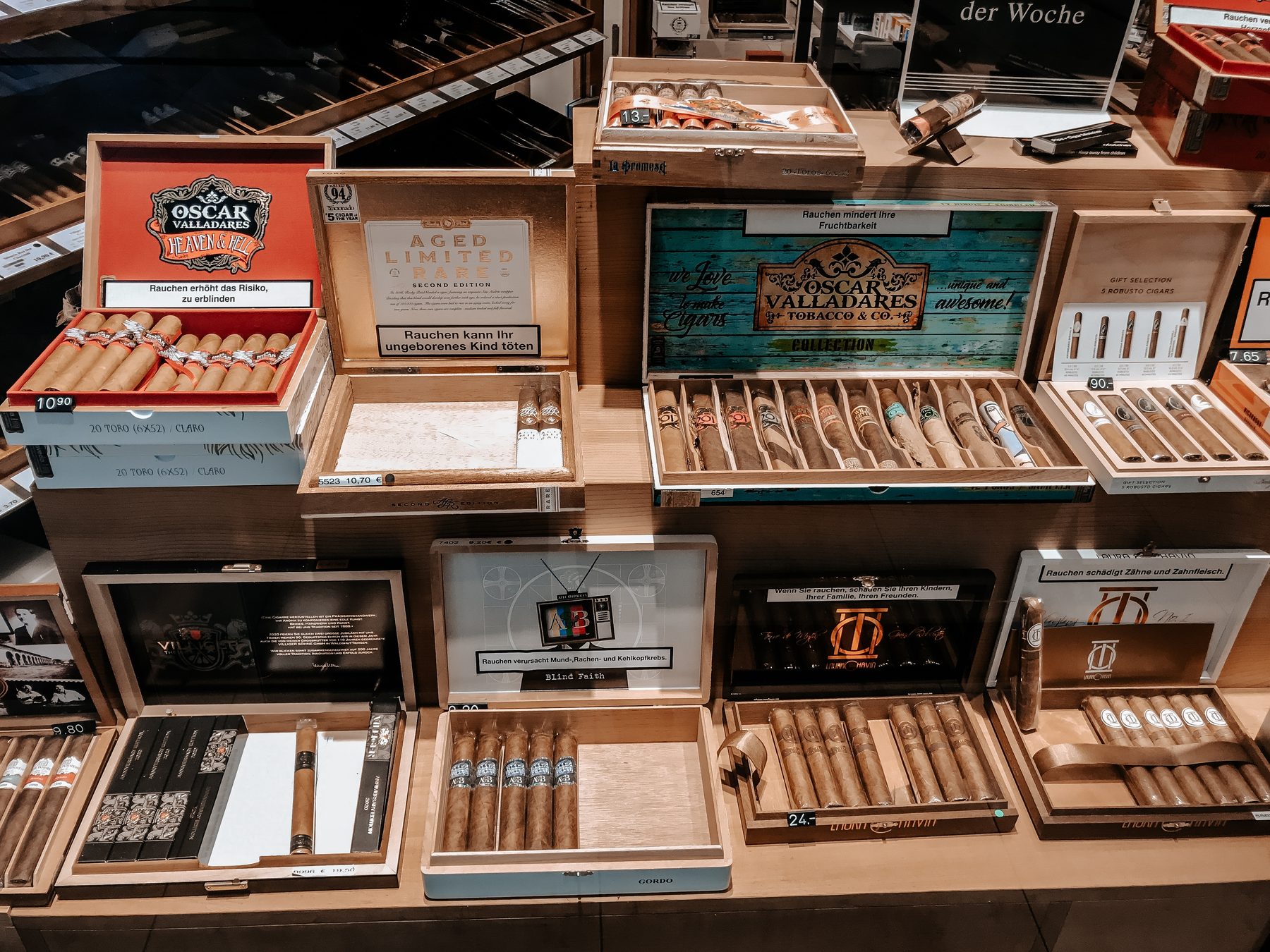
Should you buy cigars now to smoke in five years?
This is the question Part 1's economics actually points at, so let's take it seriously.
Recall the finding: aged tobacco is a financing cost, not an ingredient. A million dollars of leaf aged five extra years carries to $1.39 million before warehousing, security, and insurance. A manufacturer who wants that as a permanent line commits roughly six million dollars before selling a single cigar.
When you pay up for an aged blend, a real portion of what you're paying is somebody else's interest expense. So: can you capture that yourself by buying young and waiting?
Partly. But not the way most people assume.
The Cuban comparison breaks down
The reason Cuban smokers age everything is that Cuban cigars are shipped young. The market convention is that they need roughly three years of box age to reach their potential, and they pass through a well-documented sick period on the way. Aging Cubans isn't a refinement; it's closer to a requirement.
New World cigars are different by design. Nicaraguan, Dominican, and Honduran factories age their leaf in bales for years before rolling, and many age the finished cigars for months more after. A Padrón 1964, a Fuente Don Carlos, a Davidoff — those ship in the condition the maker intends you to smoke them in.
You cannot buy a cheap New World cigar, age it five years, and turn it into an expensive one. Patience will not manufacture a 1964 Anniversary out of a Thousand Series.
Pre-roll bale fermentation and post-roll box aging are different processes doing different chemistry. Box aging lets the wrapper, binder, and filler marry and lets residual ammonia dissipate. It does not substitute for five years of bale aging.
What consumer aging does do
| Cigar type | What happens |
|---|---|
| Full-bodied, oily Nicaraguan and Honduran | Structure to age 5–10 years and genuinely evolve |
| Strong blends generally | 1–2 years minimum to settle; 2–5 years is the sweet spot |
| Most cigars | 7–10 years is the upper limit before flavors start fading |
| Mild, shade-grown cigars | Often peak at 6–12 months; long aging can hollow them out |
| Anything past 10 years | A genuine gamble — sometimes remarkable, sometimes nothing |
One practical note that surprises people: cigars are sponges. Everything stored in the same humidor eventually shares some character. Some smokers do this on purpose. If you don't want it, separate your boxes.
The cheapest way to find out whether a cigar you like ages well is the obvious one: buy six, smoke one immediately, one at a month, one at six months, one at a year, and keep notes. That's a $50 experiment that will teach you more than any article, including this one.
The financial case is separate — and it's stronger
People conflate two questions:
Will aging make it taste better? Maybe. Depends entirely on the blend.
Is buying ahead financially sensible? Yes, and independently of the first
question.
Premium cigar prices went up again this year. The announced 2026 increases clustered in the 2–5% range — Oliva at 4%, ADV & McKay at 5%, Foundation at 2%, Fratello at 5%, Cuban prices in Spain at about 3.8% — driven substantially by tariffs on the producing countries, with the rate environment still unsettled as of this summer. That follows increases in 2025 for the same reason. This is not a one-year event.
Now price your own carrying cost.
Cost of carrying aged inventory
The one advantage you hold over the factory
The manufacturer
6%
commercial money, at scale, for years
Insured. Guarded. Warehoused.
$1M of leaf becomes $1.39M
over five years of aging.
You
$0
interest — you paid cash
Tupperdor + Boveda: ~$15
48-quart coolerdor, 200–300 cigars: under $100
Boveda refills: a few dollars a year
This is the one place in the entire supply chain where the consumer has a structural cost advantage over the manufacturer. If cigars inflate 3–5% a year and your storage runs on the order of 1% of inventory value, buying a box today to smoke over three years is a positive-carry trade before you consider whether it tastes better.
The three ways this goes wrong
Be honest about the risks, because two of them are catastrophic rather than marginal.
You don't smoke them. A box you never get through isn't a 4% annual gain, it's a 100% loss. Buy to your actual consumption rate, not your aspirational one. If you smoke two cigars a week, a box of 25 is three months of one cigar. Ten boxes is two and a half years of smoking nothing else.
Beetles. Lasioderma serricorne eggs are already inside the tobacco. They hatch when it gets warm — Holt's and Cigars International both put the ceiling at 70°F, Habanos recommends 60–64°F for long-term storage, and the risk compounds when high temperature meets high humidity. One infestation can take out an entire collection. A 4% annual gain does not survive a total loss, which makes temperature control the single highest-return thing you can spend money on if you're holding inventory. Stability matters more than hitting an exact number: a humidor averaging 68% that spikes to 74% every August is worse than one holding a steady 65% all year.
Your palate moves. The cigar you love today may not be the one you reach for in three years. Almost everyone drifts. Buying five years of one blend is a bet on a version of yourself you haven't met.
A working program
Divide your humidor into three jobs.
| Job | Share | What goes in it |
|---|---|---|
| Rotation | ~60% | Boxes of three to five cigars you genuinely reach for, bought at the lowest landed cost and replenished when the price is good rather than when you run out. Nearly all your savings live here. |
| Exploration | ~25% | Singles and 5-packs of things you haven't tried. Accept the 20% premium without complaint. It's tuition, and it's what keeps you from making $200 mistakes. |
| Sleep | ~15% | Boxes bought deliberately to sit three to five years. Full-bodied Nicaraguan and Honduran only. Label with the purchase date and forget they exist. |
And a buying cadence
- Track the five to ten cigars you buy repeatedly. Not the whole market. Prices on your rotation are the only ones that affect your annual spend.
- Buy on the dip, not on the empty. Running out is what makes people pay retail.
- Consolidate orders. One $300 order beats four $75 orders, every time, by roughly the cost of three shipments.
- Check for a coupon before checkout. A median 9.3% on top of the best price is real money on a box.
- Watch the first quarter. Cigar companies announce price increases early in the year, and retailers don't reprice until new inventory lands. There's a window.
- Compare against market, never MSRP. One of those numbers is evidence. The other is marketing.
- Spend on temperature before you spend on cabinetry. A cooler that holds 65°F beats a beautiful humidor that hits 76°F in August.
The uncomfortable summary
Everything that makes a premium cigar expensive — the five-year-aged leaf, the piece-rate rolling, the Spanish cedar box, the excise tax, the trade show booth, the free cigars handed out at three thousand shops — is settled and unchangeable by the time that box exists.
What's left for you is the last markup, the shipping, the tax jurisdiction, and the discipline not to buy twenty-five of something you've smoked once.
Handled carelessly, that's a 30–40% overpay on every box. Handled well, it's the difference between smoking what you like and smoking what you can afford.
How we measured this
Data pulled live from the StogieSpy catalog on 29 July 2026: 6,772 cigars, 83 retailers, 87,977 price observations.
Pack-size premium, within retailer. 150 randomly sampled canonical products from 28 major brands, each carried by 8+ retailers. For each retailer stocking a product in multiple pack sizes, we compared the per-stick price of the single, 5-pack, and 10-pack against that same retailer's best box price (boxes of 15+). n = 768 single comparisons, 877 five-pack, 63 ten-pack.
Pack-size premium, across market. For the same products, the best available landed per-stick price — box price plus quoted shipping, divided by count — at each pack size, across all retailers. n = 138 products with both box and 5-pack pricing, 134 with singles.
Retail dispersion. 75 products carried by 10+ retailers, boxes of 15+ only, top and bottom 5% of offers trimmed per product to remove package-quantity artifacts. Coupons. 871 products across 10 major brands; 231 carried an active coupon-adjusted price. Shipping. 3,907 offers with a quoted figure; 2,395 free, 1,512 charged.
End of the series
Back to StogieSpy Research
Three articles, one argument: almost everything about a cigar's price is settled before it reaches a shelf — and the part that isn't is the part worth your attention.